Best 1.5L engine in Malaysia: 3SZ-VE vs 2NR-VE vs L15ZE
A direct comparison of 3SZ-VE vs 2NR-VE vs L15ZE covering performance, cost, and reliability.
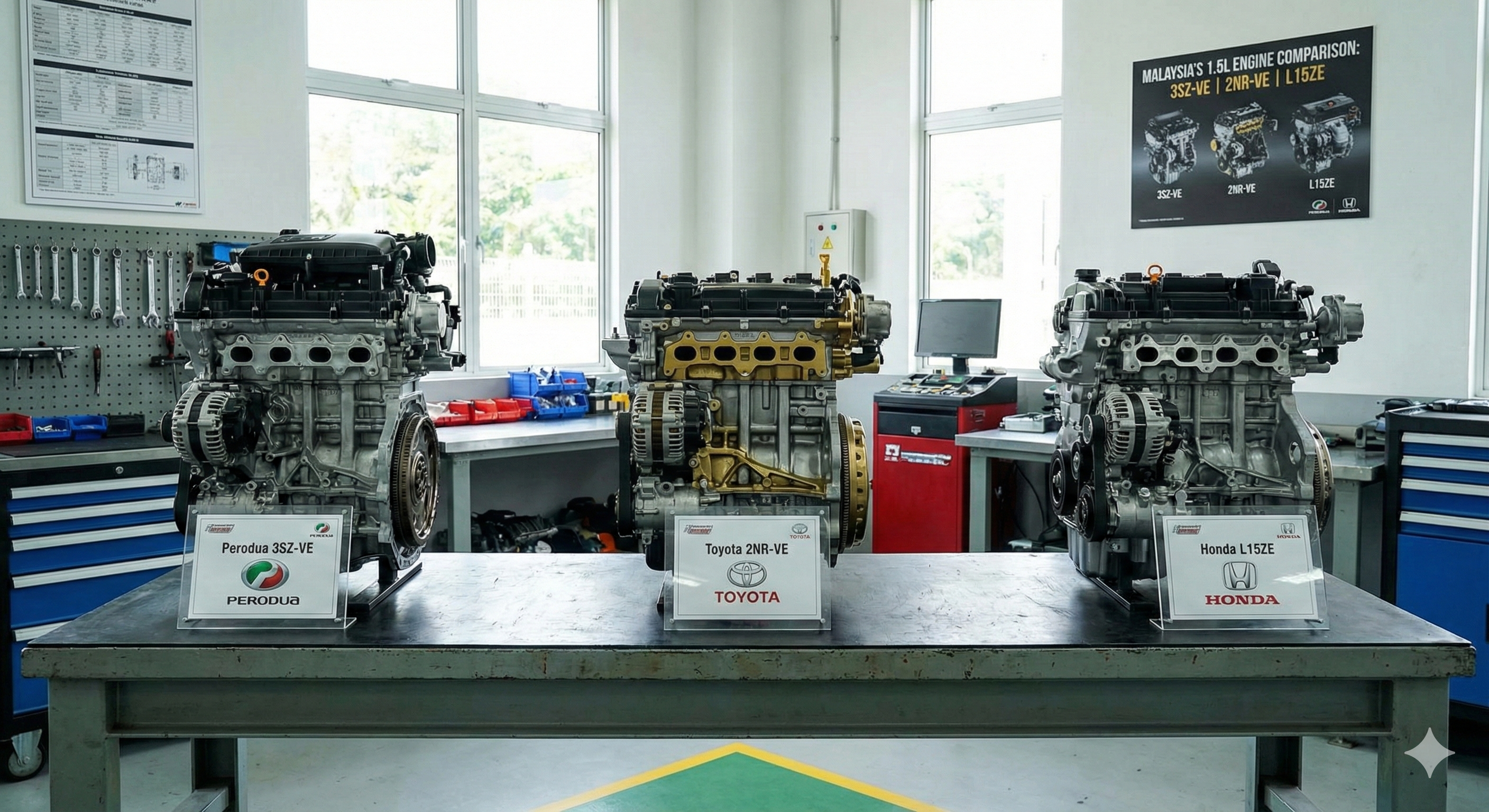
The 1.5L Battleground: Why Your Choice of Engine Defines Your Car’s Life
If you live in Southeast Asia, the 1.5-liter engine isn’t just a technical spec—it’s the heartbeat of the economy. In markets like Malaysia, the 1,500cc threshold is the “sweet spot” where tax efficiency meets daily usability. But not all 1.5L engines are created equal.
Architectural Lineage and Metallurgical Foundations
The transition from the late 1990s to the 2020s witnessed a paradigm shift in engine block casting technologies and material science. The three engines under review represent distinct eras and philosophies in block architecture, transitioning from robust iron to highly optimized aluminum alloys.
The Cast-Iron Era: Daihatsu-Toyota 3SZ-VE
Developed primarily by Daihatsu as a stroked-up iteration of the K3-VE series, the 3SZ-VE engine is a 1.5-liter (1,495 cc) double overhead camshaft (DOHC) inline-four engine. Its defining structural characteristic is the utilization of a thin-wall cast-iron cylinder block cast from FC250 gray iron. During its production run from the mid-2000s, this engine served as the backbone for Toyota and Daihatsu’s light commercial and compact passenger vehicle lineup, including the Toyota Avanza, Toyota Rush, Daihatsu Terios, Daihatsu Gran Max, and the second-generation Perodua Myvi.
While modern automotive engineering has largely abandoned cast iron in favor of aluminum for weight reduction, the 3SZ-VE’s FC250 block provides exceptional rigidity and thermal stability. Gray cast iron possesses excellent vibration-damping properties, which counteracts the secondary imbalances inherent in an inline-four configuration, resulting in a robust structure capable of withstanding severe load cycles common in commercial use. Furthermore, the inherent hardness of the iron cylinder bores eliminates the need for pressed-in steel liners or advanced plasma-sprayed bore coatings.
However, this structural rigidity comes with a severe mass penalty; the bare 3SZ-VE cylinder block weighs approximately 32.6 kg. When fully assembled, this contributes to a heavier overall front-axle weight, slightly compromising the handling dynamics of vehicles like the Toyota Rush and early Perodua Myvi models. The engine’s architecture also necessitated unusually long connecting rods—18.5 mm longer than standard requirements for this displacement—to mitigate high-RPM vibrations associated with its long-stroke design. This resulted in an increased deck height (the distance from the crankshaft center to the top of the block), making the 3SZ-VE a physically taller engine assembly.
The Aluminum Transition and DNGA Integration: Toyota 2NR-VE
Introduced to succeed the SZ family and explicitly designed for Daihatsu New Global Architecture (DNGA) applications, the 2NR-VE is a 1.5-liter (1,496 cc) engine that marks Toyota and Daihatsu’s definitive shift to lightweight materials. Built around an aluminum-alloy cylinder block with thin-wall cast-iron liners, the 2NR-VE achieves a drastic reduction in powertrain mass. It powers the modern generation of ASEAN market leaders, including the third-generation Perodua Myvi, Perodua Alza, Perodua Aruz, Toyota Vios, and Toyota Veloz.
The use of an open-deck aluminum block reduces the total powertrain weight, which directly translates to improved vehicle dynamics, lower rolling resistance, and reduced parasitic losses during acceleration. However, aluminum has a higher coefficient of thermal expansion than cast iron. To manage this, the 2NR-VE utilizes an integrated cooling jacket design optimized for rapid warm-up, addressing the specific heat dissipation characteristics of the alloy. Toyota engineered this block not for maximum horsepower, but for superior thermal efficiency and reduced manufacturing costs, ensuring it could be deployed across both transversal (front-wheel drive) and longitudinal (rear-wheel drive) platforms without major structural redesigns.
High-Flow Dynamics and Structural Rigidity: Honda L15ZE/ZF
The Honda L-series engine, specifically the L15ZE (and its GN2 platform derivative, the L15ZF) found in the Honda City, City Hatchback, and base-model HR-V, also utilizes a high-pressure die-cast aluminum block. Honda’s metallurgical approach in the L-series incorporates a highly rigid lower block structure with a deep-skirt design and a heavily ribbed oil pan to minimize lower-end noise, vibration, and harshness (NVH).
The L15ZE block is uniquely positioned because it shares foundational architectural DNA with its turbocharged variants (the L15B and L15C series). Consequently, the naturally aspirated L15ZE block is essentially over-engineered for its specific power output, providing massive structural safety margins. This allows the engine to tolerate sustained high-RPM operation without the risk of lower-end bearing failure or block distortion, a critical factor given its class-leading 6,600 RPM peak power threshold.
Bore and Stroke Configurations
| Specification | 3SZ-VE | 2NR-VE | L15ZE |
|---|---|---|---|
| Displacement | 1,495 cc | 1,496 cc | 1,498 cc |
| Bore × Stroke | 72.0 mm × 91.8 mm | 72.5 mm × 90.6 mm | 73.0 mm × 89.4 mm |
| Bore/Stroke Ratio | 0.78 (Highly Undersquare) | 0.80 (Undersquare) | 0.81 (Undersquare) |
| Crankshaft Offset | Yes (Desaxe design) | Yes | Yes |
Valvetrain Topologies and Aspiration Management
The methods by which these engines control the ingestion of atmospheric air and the expulsion of exhaust gases represent the most significant generational leaps in their respective designs.
Reactive Single-Axis Timing: 3SZ-VE
The 3SZ-VE utilizes a conventional DOHC 16-valve architecture driven by a maintenance-free, 7-piece timing chain kit comprising the chain, cam sprockets, crank sprocket, tensioner, and chain guides. Valve clearances are mechanically set between 0.15 mm and 0.24 mm (cold).
The engine features Toyota’s VVT-i (Variable Valve Timing with intelligence) strictly on the intake camshaft. This system uses engine oil pressure, regulated by an Oil Control Valve (OCV), to advance or retard the intake cam phasing based on engine load, throttle position, and RPM. While highly effective at broadening the torque curve compared to fixed-timing engines, it remains a reactive, single-axis system. Because the exhaust camshaft timing is fixed, the engine cannot control exhaust scavenging dynamically, leaving thermodynamic efficiency on the table during part-throttle cruising scenarios.
Proactive Dual-Axis Timing: 2NR-VE
The 2NR-VE rectifies the volumetric limitations of its predecessor by implementing Dual VVT-i. By adding a secondary phase controller to the exhaust camshaft, the engine control unit (ECU) gains absolute authority over “valve overlap”—the brief mechanical period where both intake and exhaust valves are open simultaneously at the top of the exhaust stroke.
Through precise, continuously variable manipulation of valve overlap, the 2NR-VE can induce an internal Exhaust Gas Recirculation (EGR) effect. By retarding the exhaust cam closing event, a calculated volume of inert exhaust gases is pulled back into the combustion chamber during the subsequent intake stroke. This effectively reduces pumping losses (as the engine does not have to pull as hard against a closed throttle plate), lowers peak combustion temperatures, and severely limits the formation of Nitrogen Oxides (NOx), all while improving part-throttle fuel economy. This implementation is a critical factor explaining why models like the Perodua Myvi and Toyota Vios exhibit vastly superior highway cruising efficiency compared to older 3SZ-VE powered variants.
Advanced Valve Lift and Phasing: Honda L15ZE i-VTEC
Honda’s L15ZE (and its GN2 platform derivative, the L15ZF) represents the pinnacle of naturally aspirated valvetrain complexity in this displacement class. Historically, Honda’s 1.5-liter engines (like the older L15A and L15Z1) utilized a Single Overhead Camshaft (SOHC) configuration. SOHC designs are lightweight, compact, and reduce internal friction, but they limit the optimal placement of the spark plug and restrict the angles at which the valves can be positioned.
With the GN2 generation, Honda transitioned the L-series to a true DOHC layout. This architectural shift allowed for the implementation of a full i-VTEC system combined with VTC (Variable Timing Control). While the Toyota 2NR-VE only phases the camshafts (rotating them forward or backward relative to the crankshaft), the Honda L15ZE incorporates physical cam profile switching.
The mechanical elegance of the i-VTEC system lies in its dual-profile camshafts. At lower RPMs, the engine operates on a mild cam profile featuring low lift and short duration. This maximizes intake air velocity through the narrower opening, resulting in superior fuel atomization, enhanced cylinder swirl, and robust low-end torque for city driving.
Once the engine crosses a specific RPM and load threshold (typically around 4,000 RPM), the ECU triggers a hydraulic spool valve. This valve directs high-pressure engine oil into the rocker arm assembly, forcing a mechanical locking pin to engage. This pin binds the primary rocker arms to a secondary, high-lift rocker arm that rides on an aggressive central cam lobe. This physically opens the intake valves wider and keeps them open for a longer duration, flooding the cylinders with atmospheric air.
The synergistic combination of VTC (continuously adjusting the timing phase) and VTEC (altering the physical valve lift) yields an engine that essentially functions as two distinct powerplants: an economy motor below 4,000 RPM and a high-breathing performance motor as it approaches its 6,600 RPM redline.
Thermal Management and Volumetric Efficiency
Thermal efficiency—the percentage of chemical fuel energy successfully converted into mechanical work rather than lost as waste heat—is heavily influenced by static compression ratios and exhaust manifold architectures.
Compression Ratios and Knock Mitigation Strategies
The static compression ratio of an engine dictates its theoretical maximum thermal efficiency. However, increasing compression raises the risk of pre-ignition (knock), especially in markets where high-octane fuel is not universally available.
Toyota 3SZ-VE: Operates at a conservative 10.0:1 compression ratio. This lower compression safeguards the engine against pre-ignition when operating on low-grade, sub-RON 95 fuels commonly found in rural Southeast Asian sectors and commercial fleet applications. It trades peak efficiency for absolute fuel tolerance.
Toyota 2NR-VE: Pushes the compression ratio to a highly efficient 11.5:1, though certain regional Euro 4 variants are mapped at 10.5:1. High compression squeezes the air-fuel mixture tighter, resulting in a more violent, energy-dense expansion during the power stroke. The engine requires at least RON 95 unleaded fuel and utilizes advanced knock sensors to actively retard timing if poor fuel quality is detected.
Honda L15ZE: Typical Honda L-series naturally aspirated architectures maintain a compression ratio ranging between 10.2:1 and 10.6:1. This ratio perfectly balances the high RPM requirements of the i-VTEC system with regular unleaded fuel compatibility, preventing the engine from pulling timing aggressively under high-load, high-RPM scenarios.
The Integrated Exhaust Manifold Advantage (2NR-VE)
A third-order engineering insight reveals exactly why the 2NR-VE achieves superior real-world efficiency over the 3SZ-VE during short, urban commutes. The 2NR-VE incorporates an exhaust manifold that is cast directly into the aluminum cylinder head.
In traditional engines like the 3SZ-VE, a heavy cast-iron or tubular steel exhaust manifold is bolted to the side of the cylinder head. Upon cold start, the exhaust gases must transfer heat into this external mass before the downstream catalytic converter reaches its “light-off” temperature (the critical temperature at which the catalyst effectively scrubs emissions). During this warm-up phase, the ECU must run an open-loop, fuel-rich map to keep the engine running smoothly, which wastes significant fuel.
By integrating the manifold directly into the cylinder head, the 2NR-VE surrounds the exhaust runners with the engine’s internal water jacket. This provides dual thermodynamic benefits:
Rapid Thermal Stabilization: The extreme heat of the exhaust gases instantly heats the engine coolant, bringing the aluminum block up to optimal operating temperature significantly faster. This minimizes the period where the ECU runs a rich “cold-start” map, drastically saving fuel on short 5–10 km urban trips.
High-Load Cooling and Fuel Conservation: Under sustained high-RPM driving or heavy loads, the coolant extracts heat from the exhaust gases before they reach the catalytic converter. In traditional engines, the ECU is forced to dump excess raw fuel into the cylinders under high load merely to cool the catalytic converter and prevent core meltdown. By pre-cooling the exhaust gases via the water jacket, the 2NR-VE avoids this “fuel dump,” saving fuel under heavy loads.
Honda utilizes similar coolant-jacketed exhaust designs in its modern engine architectures, leveraging the same thermodynamic principles to achieve strict global emissions compliance while maintaining high specific outputs.
Performance Benchmarks and Output Characteristics
Analyzing the raw output data exposes the differing philosophies of the manufacturers: prioritizing utility and load-bearing capacity versus passenger car performance and acceleration.
Transmission Synergies and Drivetrain Integration
Theoretical engine efficiency is only realized when paired with an optimized transmission. The operational economics of these three engines diverge drastically when subjected to real-world driving conditions, dictated largely by their respective gearboxes.
The 3SZ-VE Paradigm: 4-Speed Automatic Limitations
Historically mated to a conventional 4-speed automatic transmission (4AT) or a 5-speed manual, the 3SZ-VE suffers from a limited gear spread. At highway speeds (110 km/h), a 4AT forces the engine to spin at nearly 3,000 RPM, sitting entirely outside its optimal Brake Specific Fuel Consumption (BSFC) island. The engine’s mapping is inherently sensitive to throttle inputs, designed to feel “nimble” from a standstill, but this results in rapid throttle tip-in and high instantaneous fuel utilization. Because the transmission cannot drop the RPMs low enough during high-speed cruising, the engine burns excess fuel simply to overcome its own internal friction.
The 2NR-VE and D-CVT Synergy
The 2NR-VE, as utilized in the modern Perodua Myvi, Bezza, and Toyota Vios, is mated to a Continuously Variable Transmission (CVT)—specifically Daihatsu’s Dual-Mode CVT (D-CVT). The D-CVT is an engineering marvel in the compact car segment. It utilizes a traditional steel belt for low-to-medium speeds but engages a direct gear-drive mechanism for high-speed cruising.
This hybrid approach eliminates the “rubber-band” efficiency loss typical of standard CVTs at high speeds. It allows the 2NR-VE to drop to exceptionally low RPMs at highway cruising velocities, drastically reducing pumping losses. Furthermore, the integration of an Eco-Idle (start-stop) system entirely halts fuel consumption during stationary traffic periods, a critical efficiency feature entirely absent in the older 3SZ architecture.
Honda L15ZE Earth Dreams Efficiency
The L15ZE in the Honda City GN2 utilizes Honda’s proprietary Earth Dreams CVT. Despite generating the most power, it operates with staggering efficiency. The CVT constantly adjusts the gear ratio to lock the engine at its peak torque output (4,300 RPM) during hard acceleration, maximizing thrust, and instantly drops it to sub-2,000 RPM during steady-state cruising to minimize fuel flow. Unlike the Daihatsu D-CVT, the Honda unit relies entirely on advanced belt-and-pulley fluid dynamics rather than a split-gear mechanism, offering an incredibly smooth, linear power delivery that masks the engine’s transition from the low-cam to the high-cam VTEC profile.
Real-World Fuel Economy Analytics
Laboratory fuel economy claims rarely match real-world telemetry, particularly in the hot, humid, and highly congested driving conditions typical of Malaysia and the wider ASEAN region. Analyzing crowdsourced data and long-term ownership reports provides a clearer picture of true operational economics.
Perodua Myvi / Toyota Vios (2NR-VE):
While official figures suggest fuel economy upwards of 21.1 to 22.2 km/L , real-world crowdsourced data confirms highly variable but efficient performance. In heavy urban traffic, owners report between 12 km/L and 16.5 km/L depending on idle times and air conditioning load. On pure highway cycles, maintaining speeds below 110 km/h, the 2NR-VE can achieve between 17.5 km/L and 21.2 km/L. This is a massive improvement over the older 3SZ-VE, which typically struggled to exceed 10 km/L to 13 km/L in similar mixed conditions.
Honda City GN2 (L15ZE):
The official combined consumption for the L15ZE is rated at 5.4 to 5.6 L/100km (approximately 17.8 to 18.5 km/L). Real-world telemetry demonstrates that conservative highway driving can yield extraordinary numbers up to 22.0 to 24.6 km/L, effectively matching or beating the lower-powered Perodua/Toyota options. Heavy urban commuting drops the L15ZE to a still-respectable 14.0 to 16.5 km/L. Honda achieves this parity despite having a 15% power advantage, proving the sheer thermodynamic efficiency of the DOHC i-VTEC architecture.
Mechanical Durability, Lifecycle Failure Modes, and Maintenance Economics
The primary metric of success for a B-segment powertrain is its ability to operate flawlessly beyond 100,000 kilometers with a minimal Total Cost of Ownership (TCO). A deeper analysis of the failure modes reveals what consumers can expect as these engines age.
Durability Profiles and Known Failure Modes
3SZ-VE Reliability:
The 3SZ-VE is virtually indestructible under abuse, which explains its immense popularity in commercial applications, taxi fleets, and off-road capable vehicles like the Daihatsu Terios. It utilizes a highly durable timing chain rather than a timing belt, saving owners costly scheduled replacements. The most common failure mode is minor timing chain stretch or tensioner rattle upon cold starts, almost exclusively occurring if oil change intervals are neglected (typically when owners exceed 15,000 km between changes). Additionally, beyond 150,000 km, valve cover gasket leaks and minor oil consumption can occur, though these rarely lead to catastrophic mechanical failure and are easily rectified by tightening bolts or replacing cheap rubber seals.
2NR-VE Reliability:
The 2NR-VE maintains Toyota’s reputation for reliability by deliberately avoiding the complexities of direct fuel injection and turbocharging. The engine utilizes conventional port injection, which constantly washes the back of the intake valves with gasoline, preventing the severe carbon buildup issues endemic to direct-injected engines. Common, albeit minor, issues reported by users include slight engine oil consumption as the engine ages past 150,000 km. Because the block is made of aluminum, the engine is inherently less tolerant of severe overheating compared to the cast-iron 3SZ-VE; a failed water pump or an ignored radiator coolant leak can quickly warp the aluminum cylinder head, causing blown head gaskets. Engine mounting wear is also noted as a consumable around the 100,000 km mark due to the transverse packaging vibrating under load.
Honda L15ZE Reliability:
Honda’s naturally aspirated L-series engines are historically robust, capable of easily exceeding 250,000 km with basic maintenance. It is critical to differentiate the NA L15ZE from its turbocharged siblings (the L15B7/L15BE found in the Civic and Accord). The turbocharged variants suffer from well-documented oil dilution issues—where high-pressure direct fuel injection pushes raw fuel past the piston rings into the oil sump, particularly in cold climates—and head gasket failures due to narrow cooling passages under high boost pressures.
The naturally aspirated L15ZE circumvents these entirely. Like the 2NR-VE, it utilizes Port Fuel Injection (PGM-FI), completely preventing both carbon buildup and severe oil dilution. Common faults for the Honda platform are largely limited to ancillary components rather than the core engine block: CVT transmission judder (which occurs if the specific Honda HCF-2 transmission fluid is not changed strictly at 40,000 km intervals), engine mounting degradation, and occasional starter motor failures past 100,000 km.
Maintenance Economics and Total Cost of Ownership (TCO)
In the ASEAN context, Perodua/Toyota (utilizing the 3SZ-VE and 2NR-VE) and Honda operate distinct service pricing models.
Perodua/Toyota Ecosystem (2NR-VE / 3SZ-VE):
Regular maintenance intervals are set at 10,000 km or 6 months. Standard minor services, which include fully synthetic or semi-synthetic 0W-20 or 5W-30 engine oil, an oil filter, and labor, cost approximately RM150 to RM300. Major intervals (typically at 40,000 km and 80,000 km), which include spark plugs, brake fluid flushing, and CVT fluid replacement, usually range from RM600 to RM800. The widespread availability of OEM and third-party parts ensures the 2NR-VE remains one of the cheapest engines to maintain globally.
Honda Ecosystem (L15ZE):
Service intervals are similarly spaced at 10,000 km or 6 months. Minor services average RM200 to RM400 depending on the dealership. Major services at 40,000 km and 100,000 km—which include costly high-lifespan iridium spark plug replacements, fuel filter swaps, and specialized CVT fluid—can escalate to RM800 to RM1,200. While marginally more expensive than the Perodua/Toyota ecosystem in terms of raw part costs, Honda occasionally bundles free labor packages to offset the long-term TCO.
Strategic Implications and Final Conclusions
An exhaustive review of the physical architecture, thermodynamic mechanisms, and real-world telemetry of the 3SZ-VE, 2NR-VE, and L15ZE engines reveals distinct engineering philosophies tailored to disparate consumer demographics.
The 3SZ-VE is a masterclass in brute durability. By utilizing a heavy cast-iron block and a desaxe offset crankshaft, Daihatsu engineered a powertrain capable of surviving intense commercial and fleet abuse. Its low compression ratio allows it to run on sub-standard fuels without catastrophic detonation. However, its lack of dynamic exhaust timing, combined with an undersquare geometry that severely limits high-RPM efficiency and a heavy physical footprint, renders it technologically obsolete in the face of modern emissions standards and fuel economy requirements.
The 2NR-VE represents the optimization of economic mobility. Toyota and Daihatsu actively chose not to pursue maximum horsepower. Instead, they engineered a lightweight aluminum block with an integrated exhaust manifold and Dual VVT-i to maximize thermal efficiency, minimize cold-start emissions, and pair seamlessly with an advanced D-CVT transmission. It is the definitive engine for consumers prioritizing low fuel consumption, exceptionally cheap maintenance, and reliable point-A-to-point-B transportation, completely unfazed by harsh ASEAN road conditions and severe traffic congestion.
The Honda L15ZE is the zenith of B-segment naturally aspirated performance. By transitioning to a DOHC architecture and deploying the full mechanical suite of i-VTEC (cam profile switching) and VTC (cam phasing), Honda successfully engineered a dual-character powertrain. It achieves best-in-class power (121 PS) and high-RPM volumetric efficiency while utilizing reliable port injection and a highly calibrated CVT to maintain real-world fuel economy figures that rival or beat the more conservative Toyota 2NR-VE. It serves the demographic demanding driving dynamics, superior highway passing acceleration, and refinement without the long-term reliability risks associated with small-displacement direct-injected turbocharging.
Ultimately, the displacement of the 3SZ-VE by the 2NR-VE highlights the automotive industry’s irrevocable pivot toward thermal efficiency and mass reduction. Meanwhile, Honda’s L15ZE proves that naturally aspirated technology, when paired with advanced valvetrain fluid dynamics and uncompromising structural block design, can still achieve remarkable specific outputs without sacrificing the economic viability and reliability required by the global compact car market.
The Honda L15ZE represents the pinnacle of naturally aspirated B-segment engine design, offering a compelling blend of performance, efficiency, and refinement. Its advanced valvetrain technology and robust construction make it a formidable competitor in the compact car segment.